ISO/IEC 17025 accredited calibration is defined as the process by which a testing or calibration laboratory demonstrates technical competence through formal assessment by an accreditation body, producing results that are metrologically traceable to SI units and internationally recognized. Quality control personnel and lab managers who rely on calibration services need to understand that accreditation under ISO/IEC 17025 is not simply a certificate on a wall. It is a verified, ongoing commitment to measurement validity, personnel competence, and defensible audit documentation. Bodies such as ANAB and A2LA conduct the formal assessments that grant this status, and their certificates carry weight under regulatory scrutiny worldwide through the ILAC Mutual Recognition Arrangement.
What are the core requirements of ISO/IEC 17025 accredited calibration?
ISO/IEC 17025:2017 is the current authoritative standard, structured around eight core sections covering general requirements, structural requirements, resource requirements, process requirements, and management system requirements. The 2017 revision incorporated a risk and opportunity-based approach aligned with ISO 9001:2015, making the standard more adaptable to diverse laboratory environments. For lab managers, the most operationally significant sections are Process Requirements and Management System Requirements.
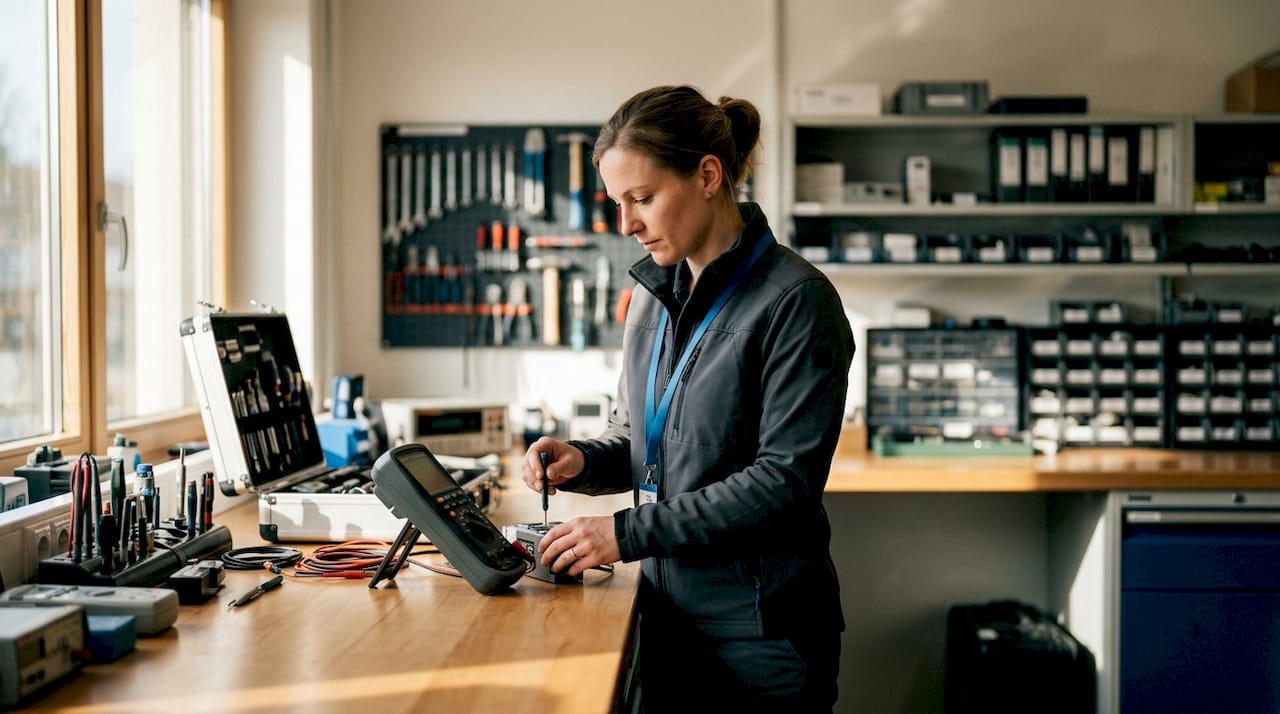
Process Requirements govern how calibration work is actually performed. They cover method selection and validation, measurement uncertainty estimation, equipment management, metrological traceability, and the handling of calibration items. Each of these areas must be documented, controlled, and demonstrably followed during any assessment.
Key technical obligations under ISO/IEC 17025 include:
- Measurement uncertainty: Every calibration result must include an uncertainty budget. Without an uncertainty budget, measurements are not considered scientifically valid or traceable.
- Metrological traceability: Results must be traceable to SI units through an unbroken chain of calibrations.
- Validated methods: Labs must use methods that are validated or verified for their specific scope of work.
- Personnel competence: Staff performing calibrations must be formally qualified and their competence documented.
- Environmental controls: Temperature, humidity, and vibration conditions must be monitored and recorded where they affect measurement results.
Accreditation also involves ongoing surveillance and continuous improvement, not a one-time achievement. Labs undergo rigorous periodic assessments by bodies like ANAB or A2LA to maintain competence and integrity over time.
Pro Tip: Review your lab’s scope of accreditation document before every new calibration project. The scope defines exactly which instruments, parameters, and measurement ranges are authorized. Calibrating outside that scope voids the accreditation status for that job.
How does 17025 accreditation differ from ISO 9001 certification?
ISO/IEC 17025 certifies technical competence, including validated methods and measurement uncertainty. ISO 9001 certifies only a quality management system. That distinction matters enormously in practice.
ISO 9001 confirms that a laboratory has documented procedures, management reviews, and corrective action processes. It does not confirm that the lab can actually produce accurate, traceable measurements. A facility can hold ISO 9001 certification and still deliver calibration results that are scientifically indefensible. ISO/IEC 17025 closes that gap by requiring proof of technical execution, not just procedural documentation.
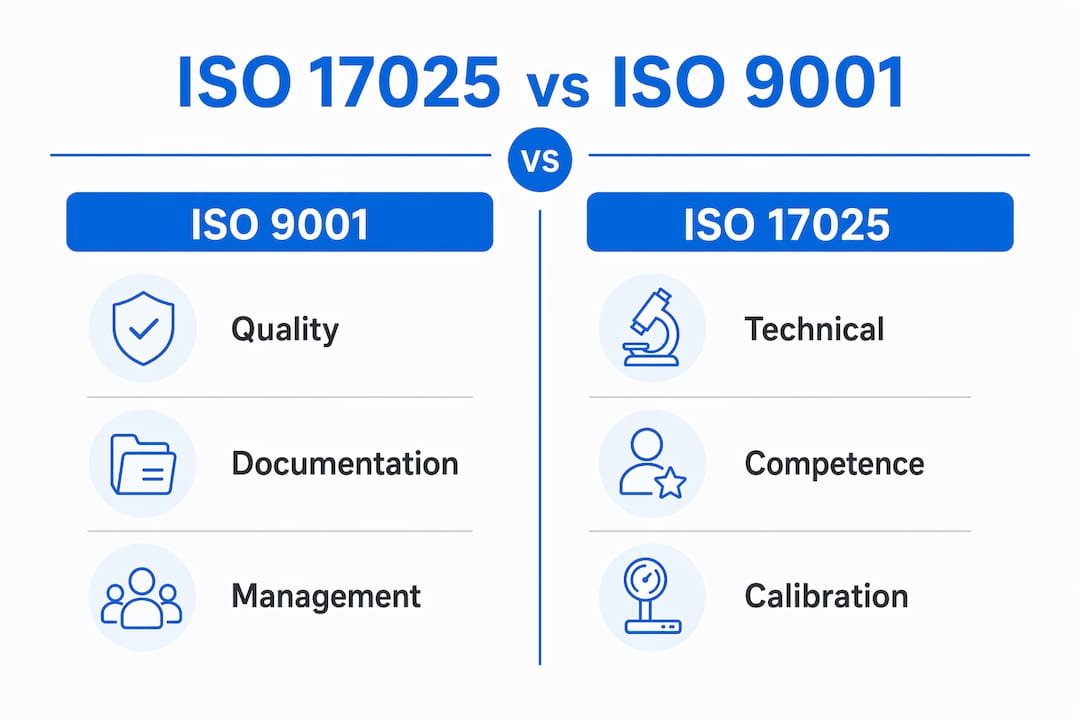
| Feature | ISO 9001 | ISO/IEC 17025 |
|---|---|---|
| Focus | Quality management system | Technical competence |
| Measurement uncertainty | Not required | Mandatory |
| Method validation | Not required | Required within scope |
| Personnel competence | General | Discipline-specific |
| International recognition | Limited for calibration | Full, via ILAC MRA |
| Audit defensibility | Moderate | High |
The practical implication for quality managers is direct. When a regulatory body, customer, or auditor requests calibration records, an ISO/IEC 17025 certificate carries far more evidentiary weight than an ISO 9001 certificate from the same lab. The scope of accreditation document that accompanies a 17025 certificate specifies exactly which instruments and parameters the lab is authorized to calibrate. That specificity is what makes the certificate defensible.
Pro Tip: Always request a copy of the calibrating lab’s scope of accreditation before submitting equipment. Confirm your instrument type, measurement parameter, and range appear explicitly in that document. If they do not, the resulting certificate will not satisfy a 17025 requirement.
What practical steps should quality managers take to obtain and maintain accredited calibration?
Achieving and maintaining accreditation under ISO/IEC 17025 follows a defined sequence. Quality managers who treat it as a project with discrete phases avoid the most common compliance failures.
Define your scope. Identify which instruments, parameters, and measurement ranges your lab needs to calibrate. The scope of accreditation is not a blanket authorization. It is a specific list, and every item on it must be supported by validated methods and appropriate reference standards.
Prepare documentation. Establish a quality manual, method procedures, equipment records, and personnel competence files before applying. Assessors from bodies like ANAB or A2LA will review these during the initial assessment. Gaps in documentation are the most common reason for delayed accreditation.
Conduct an internal audit. Run a full internal audit against the ISO/IEC 17025:2017 requirements before the formal assessment. Identify nonconformities and close them with documented corrective actions. This step prevents costly reassessments.
Submit the application and complete the intake process. The intake process for ISO/IEC 17025 calibration includes detailed equipment specifications, scope review, “before” and “after” measurement data with uncertainty, and turnaround time considerations. Provide complete instrument specifications and confirm the lab’s scope covers your equipment.
Undergo the formal assessment. An accreditation body assessor will review your documentation, observe technical work, and interview personnel. Findings are classified as nonconformities or observations. Nonconformities must be resolved before accreditation is granted.
Maintain accreditation through surveillance. Accreditation is not permanent. Labs undergo scheduled surveillance assessments and full reassessments on a defined cycle. Any change to methods, equipment, or personnel must be reported to the accreditation body.
On-site calibration reduces transit delays and risk of damage compared to off-site shipping approaches. For large, fixed, or sensitive equipment, on-site service from an accredited lab is the operationally sound choice.
Pro Tip: Build a calibration schedule that staggers instrument due dates across the year. Sending all critical instruments for calibration at the same time creates production gaps and increases the risk of missing a due date under audit pressure.
Why is 17025 accredited calibration critical for regulatory compliance and audit readiness?
Accredited calibration certificates are preferred or required in regulated industries such as pharmaceuticals, food safety, and environmental monitoring for audit and regulatory compliance. Accredited certificates carry more weight under scrutiny and provide defensible evidence in quality audits. That is not a preference. In many regulatory frameworks, it is a requirement.
The reasons accredited calibration supports audit readiness are specific:
- International recognition: Certificates from accredited labs are audit-ready and universally defensible through the ILAC Mutual Recognition Arrangement. A certificate issued by an ILAC MRA signatory is accepted by regulatory bodies in over 100 economies.
- Measurement uncertainty statements: A calibration certificate that includes a full uncertainty budget is a legally recognized document. Auditors and regulators treat it as scientific evidence, not just paperwork.
- Traceability chain: Accredited certificates document an unbroken traceability chain to SI units. That chain is what regulators in pharmaceutical manufacturing, under FDA 21 CFR Part 11, or in food safety, under ISO 22000, require as proof of measurement integrity.
- Scope specificity: The scope of accreditation confirms the lab was technically authorized to perform the specific calibration. That authorization is what separates an accredited certificate from a generic calibration report.
“A calibration certificate with measurement uncertainty is a legal document recognized worldwide and required for scientific validity and metrological traceability. Without an uncertainty budget, measurements are not considered scientifically valid or traceable.”
ISO 17025 and 10012: Quality in Metrology, Groupe AFNOR
Labs that use accredited calibration services also strengthen their internal quality assurance programs. When your reference standards are calibrated by an accredited lab, every downstream measurement your team makes inherits that traceability. That inheritance is what makes your own measurement results defensible in an external audit.
Key Takeaways
ISO/IEC 17025 accredited calibration is the only internationally recognized standard that confirms both technical competence and metrological traceability, making it the definitive requirement for audit-ready calibration in regulated industries.
| Point | Details |
|---|---|
| Accreditation confirms technical competence | ISO/IEC 17025 verifies validated methods, uncertainty budgets, and personnel qualifications, not just procedures. |
| Scope of accreditation is binding | Always confirm your instrument and parameter appear in the lab’s scope document before submitting equipment. |
| Measurement uncertainty is mandatory | A certificate without an uncertainty budget is not scientifically valid or traceable under ISO/IEC 17025. |
| Surveillance keeps accreditation current | Labs must pass periodic assessments by bodies like ANAB or A2LA to maintain their accredited status. |
| Regulated industries require accredited certificates | Pharmaceuticals, food safety, and environmental sectors treat accredited calibration certificates as legal evidence in audits. |
Why accreditation is a discipline, not a destination
After working with quality systems across manufacturing and laboratory environments, the pattern I see most often is this: labs invest heavily in achieving accreditation, then treat it as finished work. That is the wrong frame entirely.
Accreditation under ISO/IEC 17025 is a discipline that requires the same attention after the certificate arrives as before. Personnel change. Methods drift. Equipment ages. Each of those events is a potential nonconformity if it is not documented and reported to your accreditation body. I have seen labs lose accreditation not because their technical work was poor, but because they failed to notify ANAB of a method change. The technical work was fine. The administrative discipline was not.
The other mistake I see regularly is budget-driven scope creep in reverse. Labs try to get everything accredited to satisfy a general audit requirement, then struggle to maintain competence across an overextended scope. The smarter approach is to prioritize accredited calibration for mission-critical and regulatory-required instruments, and use that focus to keep your documentation tight and your assessments clean.
One more thing worth stating plainly: mixing ISO 9001 certificates with ISO/IEC 17025 certificates in your calibration records is a documentation error that auditors notice immediately. They are different documents with different evidentiary weight. Keep them separate, label them correctly, and train your team on the distinction before the next audit cycle.
— Rachmadi
Precision calibration equipment for ISO/IEC 17025 requirements
Quality managers who need instruments that meet the technical demands of ISO/IEC 17025 accredited calibration will find a broad selection at Multimeter Asia. The catalog covers over 25,000 brands, from temperature transmitter calibrators to electrical testing instruments, all sourced to support the measurement ranges and tolerance levels that accredited labs require.
The Fluke Calibration 2562 is one example of a precision instrument built for the exacting requirements of accredited laboratory work, with the measurement accuracy and documentation support that ISO/IEC 17025 compliance demands. Multimeter Asia offers free local delivery, 24/7 support, and 100% secure payments, so quality teams can source the right equipment without delays. Visit the site to review full specifications and confirm the right fit for your accreditation scope.
FAQ
What is ISO/IEC 17025 accredited calibration?
ISO/IEC 17025 accredited calibration is calibration performed by a laboratory that has been formally assessed and approved by an accreditation body, confirming its technical competence, use of validated methods, and metrological traceability to SI units.
How does ISO/IEC 17025 differ from ISO 9001?
ISO/IEC 17025 certifies a lab’s technical competence to perform calibration, including measurement uncertainty and method validation. ISO 9001 certifies only a quality management system and does not confirm scientific accuracy.
What is a scope of accreditation?
A scope of accreditation is a formal document that lists the specific instruments, measurement parameters, and ranges a lab is authorized to calibrate under ISO/IEC 17025. Calibration performed outside that scope does not carry accredited status.
Why do regulated industries require accredited calibration certificates?
Regulated industries such as pharmaceuticals, food safety, and environmental monitoring require accredited calibration certificates because they include measurement uncertainty statements and traceability chains that serve as legally defensible evidence in quality audits.
How often must a lab renew its ISO/IEC 17025 accreditation?
Labs undergo scheduled surveillance assessments and full reassessments on a defined cycle set by their accreditation body, such as ANAB or A2LA. Any significant change to methods, personnel, or equipment must be reported between cycles.
Recommended
- Fluke Calibration 9009-B-156-TRAN: Precision Temperature Transmitter Calibrator – Multimeter Asia
- Multimeter Asia – Precision Calibration Equipment
- Fluke Calibration 2562 – Multimeter Asia
Article generated by BabyLoveGrowth